Cover Story
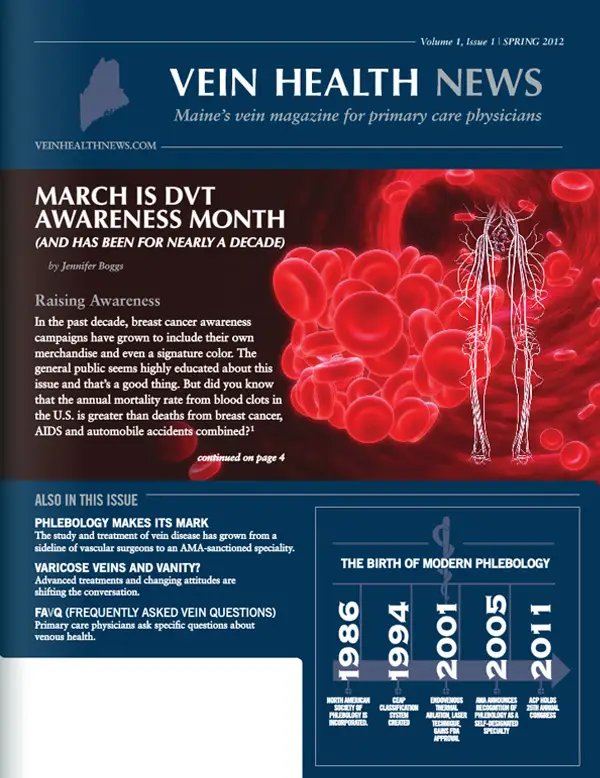
March is DVT Awareness Month (And has been for nearly a decade)
By Jennifer Boggs | Feature
A study by the Mayo Clinic estimates that more than one thousand Mainers die as a result of blood clots every year (a figure that is likely on the low side). The economic burden is also great. According to recent federal research published in the Journal of the American Medical Association, it is estimated that venous thromboembolism (deep vein thrombosis and pulmonary embolisms collectively) cost the U.S. hospital system more than $340 million per year.
In 2003, more than 50 organizations assembled in Washington, DC, to discuss the need to make DVT a national public health priority. This gathering resulted in the establishment of the Coalition to Prevent DVT, which declared March as DVT Awareness Month. Their efforts included encouraging DVT screenings, producing an educational video with mobility tips and exercises, and customizing an RV to visit hospitals and communities across the country. In Maine, then-Governor John Baldacci, proclaimed November 2008 as "Thrombosis Awareness Month" in the state.
The mission of the National Blood Clot Association (NBCA), also founded in 2003, is to educate people about the danger, prevention, and treatment of blood clots and clotting disorders, and DVT awareness is a cornerstone of its work. In 2009, the NBCA received two program grants totaling $2.6 million over five years from the Centers for Disease Control and Prevention. These funds support programs directed at curbing the devastating effects caused each year to over 350,000 Americans who develop a blood clot.
Because of the efforts of these and other patient-led and professional advocacy groups, public awareness of DVT and blood clots is increasing, but it hasn't yet reached the level of ubiquity that breast cancer awareness has.
A Brief Review of DVT
Every person's deep vein system carries about 80% of blood from the feet back up to the heart. Deep veins are located under the muscle and fascial layers in the lower extremity. The system is under a great deal of pressure, because with each step the leg takes, the muscles around the deep veins squeeze these veins and force the blood "uphill."
An obstructive clot in a deep vein can be dangerous because the high pressure could cause the clot to break free from the vein wall and enter the blood stream. The clot could then travel up through the legs, through the major vessels in the abdomen, and into the vena cava and into the right atrium. If the clot follows normal circulation, it would enter the right ventricle and then be pumped to the lungs. Once in the lungs, it would be a pulmonary embolism (PE), which can be symptom-free and/or fatal, depending upon the size and location of the clot.
If the heart has any wall defects—a condition likely found in more than 25% of patients—the clot could cross to the left side of the heart and then be pumped to the brain instead of the lungs, resulting in stroke. If the clot doesn't move, there are still other risks to consider, including post thrombotic syndrome.
Causes and Risk Factors
Virchow's triad was first formulated in 1856, but the basic principles still apply. The three broad categories of factors that are thought to contribute to thrombosis are:
- Alterations in normal blood flow, including venous stasis, turbulence and varicose veins
- Endothelium damage, often due to surgery or even trauma caused by bumping into something (usually in older patients)
- Hypercoagulable state, such as during cancer, pregnancy or congenital disorders
Anyone can get DVT, but according to Virchow's triad, there are certain groups that are at higher risk. At the top of that list are patients who experience venous stasis due to prolonged immobility or no mobility, such as those who are hospitalized or on bed rest. Seniors are often more likely to become immobile as the result of aging, injury or surgery.
There has been some attention given to the so-called "economy class syndrome," which describes the development of DVT in patients on long airplane flights. This is a misnomer, as it's not the seat location that matters, but rather the extended immobility of the patient and the small space in which he is sitting.
Diagnosing DVT
The symptoms of DVT are confined to the affected area, not always, but typically the lower leg. They include pain, swelling, tenderness, leg fatigue, redness or discoloration of the skin. Approximately half of the time, DVT has no symptoms at all. The American College of Chest Physicians (ACCP) recently released the ninth edition of The Antithrombotic Therapy and Prevention of Thrombosis. The evidence-based clinical practice guidelines include more than 600 recommendations for the diagnosis, prevention and treatment of thrombosis. The guidelines suggest that physicians use the physical exam to determine the index of suspicion for DVT, which dictates all further evaluation and care.
Simple office tests can help with the initial physical exam. A handheld plethysmography machine, for example, can help weigh your index of suspicion. Although considered to be old technology by some and not as reliable as an ultrasound, it has a high sensitivity for DVT and thus, is an excellent DVT screen.
Care and Treatment
As with all health disorders, treatment of DVT depends on many variables, including the extent and location of the clot and the patient's baseline health. Anticoagulant medications are probably the most widely used treatment to prevent further clots from forming and to diminish the risk of a PE. However, according to the ACCP's latest guidelines, physicians should consider all the options, including medical and mechanical thrombolysis, systemic thrombolysis, and filter placement.
Among people who have had a DVT, one-third experience post-thrombotic syndrome and about one-third will have a recurrence of DVT within 10 years. In recommending treatment, physicians should take into account the possible long-term effects of post-thrombotic syndrome. Symptoms include chronic leg swelling, discomfort, skin discoloration and/or scaling, and often, the development of chronic skin ulcers near the ankle. These post-thrombotic problems can be diminished if the patient faithfully wears graduated compression stockings and elevates their legs periodically during the day.
Researchers are continuing to explore a number of new options for the treatment of DVT. One study is taking place right here in Maine. Maine Medical Center is currently participating in the ATTRACT trial—Acute venous Thrombosis: Thrombus Removal with Adjunctive Catheter-directed Thrombolysis. The trial, sponsored by the National Institutes of Health, will evaluate the use of thrombolytic "clot-busting" drugs in combination with clot removal devices, to prevent post thrombotic syndrome in patients with DVT.
What You Can Do For Your Patients
Because DVT can occur with little or no warning, the best action to take is prevention. Without preventive treatment, for example, up to 60 percent of patients who undergo total hip replacement surgery may develop DVT. There is much a primary care physician can do to help their patients prevent DVT. Prolonged immobility is one of the greatest risks, and all patients entering the hospital should be aware of this. The pre-operative clearance physical is an excellent time to educate the patient regarding the pedal pump and its power, even in a supine position.
Phlebology
Making Progress: Phlebology Comes Into Its Own
By Benjamin Lee
Veins are not a new invention. But phlebology—the study and treatment of veins and venous disease—is a relatively recent field of medicine. Once a sideline of vascular surgeons (whose focus was and is mainly arteries), phlebology is a burgeoning discipline that continues to add skilled specialists to its ranks.
In 1947, Dr. Raymond Tournay coined the term phlebology: "phlebo" meaning "vein," and "ology," meaning any science or branch of knowledge. Tournay and his colleagues founded the French Society of Phlebology (SFP), also in 1947, and he was its General Secretary for many years. The "roots" of phlebology actually began as early as 1909 in Germany with the formation of an "Association of Specialists for Leg Diseases."
The American College of Phlebology (ACP) was founded in 1985 by Dr. Anton Butie, though its original name was the North American Society of Phlebology. Its purpose was to bring together physicians and surgeons from diverse specialties who shared an interest in venous disease. The Society started with just fourteen members. The organization was incorporated in 1986, and in 1997, the Society changed its name from the North American Society of Phlebology to the American College of Phlebology. Today, the ACP has over 2,000 physicians and allied health professional members.
In 2005, phlebology was approved for inclusion in the list of self-designated medical specialties sanctioned by the American Medical Association (AMA). The decision by the AMA meant that physicians who diagnose and treat venous disorders, including varicose veins, could select phlebology as their primary or secondary area of practice. In 2007, the American Osteopathic Association (AOA) followed the AMA's lead and officially recognized phlebology as a distinct practice discipline.
The American Board of Phlebology (ABPh) was established in 2007, with the overarching goal of improving medical standards related to the treatment of venous disease. One of its biggest efforts in meeting that goal was the creation of a Board Certification Exam for phlebology. According to Christopher Freed, ABPh Executive Director, diplomates are certified in phlebology by passing the "rigorous, psychometrically valid certification exam."
Treatment
A New Approach to Varicose Veins
By Diane Atwood
Bulging, tortuous varicose veins running down a person's leg are not a pretty sight. Some may consider them only a cosmetic issue, but left untreated, they can impact quality of life and lead to medical problems. Common risk factors for developing varicose veins are: Gender (more common in women); Pregnancy; Prolonged standing; Genetics.
Leg veins contain hundreds of one-way valves that allow blood to flow upward against the force of gravity. If a valve no longer functions properly, blood stills makes it up to the heart, but the veins have to work harder and blood is likely to pool inside the affected vessel. Twisted and enlarged branches or varicosities then form to compensate for the extra blood.
In addition to the appearance of varicose veins, other symptoms of venous insufficiency include: Heavy, achy, tired feeling in legs; Legs that feel better in the morning, worse in the afternoon; Swollen ankles; Itching around the vein.
Compression stockings can often abate symptoms associated with varicose veins. However, several more effective minimally invasive techniques are now available, which can be performed in the office under local anesthesia:
- SCLEROTHERAPY: treats tiny veins just below the skin's surface. Using a small needle, a sclerosant is injected into the vein, which causes it to seal shut and disappear.
- LIGHT-ASSISTED SCLEROTHERAPY: treats hard to see veins below the skin's surface. A small hand-held light illuminates the veins and makes them easier to see.
- ULTRASOUND GUIDED SCLEROTHERAPY: uses ultrasound to locate veins.
- AMBULATORY PHLEBECTOMY: treats small varicose veins that are too big to be treated with sclerotherapy. It involves interrupting and removing the vein through tiny incisions in the skin.
- ENDOVENOUS LASER ABLATION: has become the gold standard in the treatment of large varicose veins. A small laser fiber is threaded into the vein. The laser (or radio frequency waves) heats the lining of the vein, which makes it collapse, shrink, and disappear.
Ideally, people would be able to prevent varicose veins from developing in the first place. That may be impossible in many cases, but one thing that could make a big difference is wearing compression stockings during pregnancy. "Pregnancy is really hard on veins because women's hormones fluctuate wildly causing them to become more elastic," contends Dr. Robertson. "At the same time, blood volume doubles within the first several weeks."
Vein Tech
CoolTouch Endo Venous
By Benjamin Lee
For years, patients suffering from varicose veins and other effects of venous reflux had few options for treatment, among them vein stripping or ligation. Endovenous ablation has been performed in the United States for more than 14 years and is now considered the gold standard in treatment of venous symptoms. During endovenous laser ablation (EVLA), the physician uses imaging guidance to thread a small laser fiber into the vein at the failure location. The ablation probe is then guided up the problematic vein.
The CTEV (CoolTouch Endo Venous) was introduced by CoolTouch in 2005 (with FDA Clearance). The CTEV is a 1320 nm Nd:YAG laser with an absorption length of 300-500 microns (0.3-0.5mm) in tissue. In laymen's terms, all light (wavelength) looks for a chromophore (target), and each wavelength has a different depth of penetration. In this case, the 1320 nm laser targets water in the vessel wall (since collagen is primarily water), resulting in a shorter absorption length than, say, Diode lasers.
Specific absorption of energy in the vein wall results in a more controlled depth of vein coagulation than any other wavelength. Vein lasers with lesser wavelengths (870 nm or 910 nm, for instance) target hemoglobin, thus when the laser heats up the vein wall, it "cooks" the blood within the vein. The result is often more pain, swelling and bruising than with the 1320 nm.
According to CoolTouch, more than 95% of patients have had their varicose veins closed with only one treatment using the CTEV. Since the procedure destroys the entire lining of the vein, the opportunity for new collateral veins to grow is greatly minimized.
FAVQ
Frequently Asked Vein Questions
By Dr. Cindy Asbjornsen
What is the proper post-treatment protocol for patients who undergo vein treatment?
Every vein specialist has his or her own approach. I strongly believe that treatment does not end once the procedure is over. Consistent follow up is key to long-lasting success. I typically see my patients within three or four days after the procedure, again after two months, and then again after six months. The immediate follow up is to ensure that there were no adverse effects. At two months I check to confirm that all veins are resolving. The six-month follow up is to make sure that the patient is 100% satisfied with their treatment and a chance for me check on any other potential vein issues. If he or she still has persistent veins, I will schedule one final check-up six months later.
When I discharge a patient, I try to always leave the door open for new concerns or issues. Venous disease is chronic in nature and although the veins I treat will not come back, veins in other parts of the lower extremities could become problematic.
When should I refer a patient to a vein specialist?
When a patient is experiencing symptoms or is inquiring about spider or varicose vein removal, that is a good time to refer. While the presence of venous insufficiency can often be diagnosed in the superficial vein, only comprehensive examination by a Phlebologist can identify the source and best treatment options for an individual. I also suggest referral if you have a patient with known risk factors who is entering a high-risk period. For example, if you have a patient who is planning to become pregnant whose mother developed venous issues with her pregnancies.
How do I differentiate between varicose veins that are a cosmetic issue or a medical issue?
This is a difficult question to answer, because it depends on whose perspective you adopt. Insurance companies tend to base this on whether or not a vein has a connection to the deep system; if it does and the connection is leaking, then they consider medical treatment necessary. (That said, there are many vein procedures that are covered by insurance, and one should not assume that a varicose vein treatment will not be covered.) I think most healthcare providers would agree, however, that if a patient is having pain and is unable to perform his or her work that treatment is medically necessary.
But I would go one step further and say that even if a patient isn't experiencing physical pain—but won't swim in a pool or wear shorts to the beach because he or she is ashamed of varicose veins—his or her quality of life is markedly diminished. All factors must be weighed when drawing a line between medical and "simply cosmetic," not the least of which is restoring patients' confidence and overall well-being.
Patient Perspective
One Patient's Perspective: Life After DVT
By Benjamin Lee
In 1983 Brian Gaudrau and a friend took a bus trip from Maine to Florida. By the time they got to the Carolinas, Gaudrau started noticing six lumps in his left leg, all in one vein. When they finally arrived at their vacation destination, he went straight to the hospital. He stayed there for two weeks. Deep vein blood clots had developed. Fortunately, none of the DVTs had embolized, and treatments with Heparin and heat therapy reduced them enough for him to travel safely home.
Once Gaudrau got back to Maine, his family doctor referred him to a local vascular surgeon who prescribed Coumadin to manage the clots, and then removed the entire vein. At that point, Gaudrau started developing severe ulcers in his left leg (the leg where the DVTs were). For the next twenty years he sought treatment from several vascular specialists in New England, including one doctor who gave him a vein valve transplant in the late 1990's, but nothing seemed to relieve his pain or heal his ulcers.
A few years ago, with encouragement from his wife, Gaudrau went to a wound care clinic in southern Maine. At the clinic, he received excellent treatment, as well as a referral to a local phlebologist. It was then he discovered the root of his problem: faulty perforator veins in his leg were causing his blood to flow backwards and pool in his legs, keeping his ulcers open. The solution—after a thorough examination and detailed medical history—was to treat the troublesome veins at the source of the dysfunction, using ultrasound-guided sclerotherapy to seal the veins shut.
Since the sclerotherapy, Gaudrau has begun to see light at the end of the tunnel. "The ulcers are slowly closing, and the results I'm seeing are unbelievable," he said. "It's the best my leg has felt in years." Gaudrau continues to undergo sclerotherapy and will do so until his leg pain and ulcers are completely gone. Because of the DVT and venous reflux that followed, the skin on the lower half of his affected leg now appears to have a "woody" texture, but he's receiving treatment for that too.
Before sclerotherapy, Gaudrau's pain was so bad he could barely walk, compounding the problem. Now he says that he and his wife go for walks on the beach together. What he'd really like to do is go swimming, something he hasn't been able to do for more than fifteen years. "My primary goal is no more pain, but my other goal is to go for a swim without any plastic bags or contraptions on my leg," he said. "I think we can make that happen."
Concerned about your vein health?
Contact the Vein Healthcare Center for an evaluation.
Contact Us