Cover Story
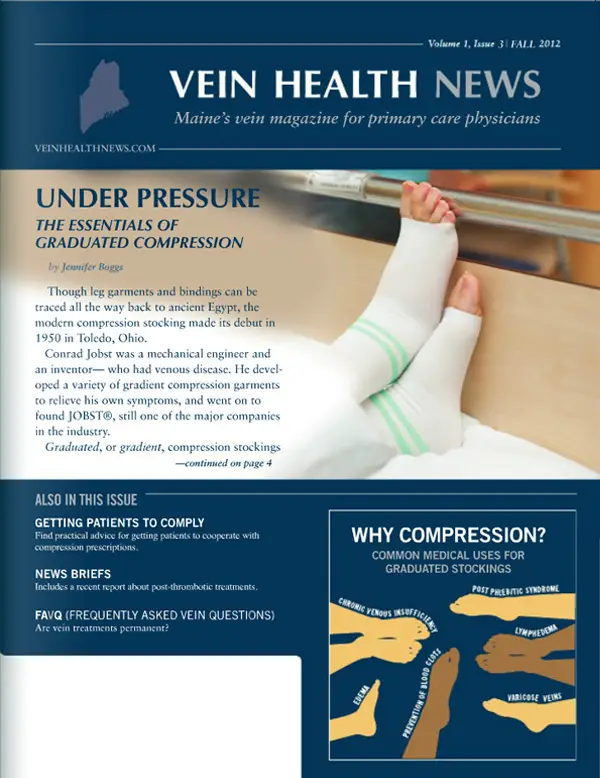
Under Pressure: The Essentials of Graduated Compression
By Jennifer Boggs | Feature
Though leg garments and bindings can be traced all the way back to ancient Egypt, the modern compression stocking made its debut in 1950 in Toledo, Ohio. Conrad Jobst was a mechanical engineer and an inventor—who had venous disease. He developed a variety of gradient compression garments to relieve his own symptoms, and went on to found JOBST®, still one of the major companies in the industry.
Graduated, or gradient, compression stockings play a significant role in venous care. They can prevent vein problems from occurring, relieve venous disease symptoms (thus, stopping its progression), and decrease the likelihood of a clot. While wearing compression, patients frequently report that their symptoms are significantly improved, if not completely alleviated. Ample data proves that compression can reduce the recurrence of varicose veins and venous ulcers.
Compression is also crucial in both the acute and chronic management of patients with Deep Vein Thrombosis (DVT). Wearing compression stockings reduces the incidence of post-thrombotic syndrome (chronic pain and swelling in the leg after DVT) by half when worn for two years following DVT, according to recommendations by the American College of Chest Physicians. When there are risk factors for DVT, such as long distance, immobility, or pregnancy, wearing compression can reduce its occurrence.
How it works
Venous disease is defined as the impairment of blood flow towards the heart. Healthy veins have valves that open and close to assist the return of blood to the heart. Venous disease—also called vein insufficiency or reflux—occurs if these valves become damaged, allowing the backward flow of blood in the legs. Because gravity works on the legs more than on other parts of the body, these vein walls are under tremendous pressure.
Medical compression provides a gradient of pressure against the leg. The pressure is highest at the foot and ankle and gradually decreases as the garment rises up the leg. This pressure gradient makes it easier for the body to pump blood up towards the heart (the normal direction) and more difficult for gravity to pull blood downward. Compression also increases the pressure in the subcutaneous tissue, thereby helping to reduce and prevent swelling by moving excess fluid back into the capillaries.
Gradient compression is expressed in millimeters of mercury, or mmHg. It is the measurement of how much compression or squeeze that is placed on the leg: the higher the number, the greater the compression. Stockings are graded on the basis of the strength of the compression at the ankle. Commonly prescribed strengths include 15-20 mmHg for spider veins, or patients with varicose veins but only mild symptoms or swelling; 20-30 mmHg for mild to moderate varicose veins; and 30-40 mmHg for patients with varicose veins associated with symptoms such as pain and swelling.
Getting a good fit
These days, compression stockings are fashionable, comfortable, and come in a wide variety of styles and colors. There is a stocking for everyone, but it takes time to find one that fits a patient—and his or her lifestyle—well. Susan Price, a Certified orthotic fitter (Cfo) at Maine Orthotic and Prosthetic, believes that a good fit isn't just important—it's essential. "If you don't have a good fit, the garment can be too tight and actually cut off your circulation, the opposite of what it's designed to do," she said.
Every patient who schedules a fitting requires a doctor's prescription detailing the diagnosis, style (knee-high, thigh-high, or pantyhose) and level of compression. When Price fits for compression garments, she starts with a standard evaluation, which includes medical history and a review of the referring doctor's orders. Though fittings can be scheduled throughout the day, morning is the ideal time, because swelling worsens throughout the day. Price will typically measure the patient's ankle, calf and length of the calf, in addition to other measurements.
Donning and Doffing
If a patient can't get his/her stockings on and off, then there's almost no chance of compliance. Thus, teaching patients how to get stockings on and off is a critical part of the fitting process. In fact, part of Price's evaluation is getting a sense of what each patient can or is willing to do. For example, does the person have difficulty bending over because of back problems? Are his/her hands weak due to arthritis?
Modern compression stockings usually look like socks or tights, but putting them on can be far more difficult. When putting socks on, you gather up many layers of fabric and stretch them over your foot. With compression stockings, the multiple layers of elasticized fabric require too much strength to stretch over the foot—so patients should pull their stockings up like trousers. The best technique is to open the garment from the top and then work on getting the heel into place before bringing the stockings up.
Most compression garments last about six months (with everyday use), before the ankle compression begins to decrease and lose its shape. Garments are best cared for when hand-washed and air-dried, but just last year companies began producing hosiery that can be safely machine-washed and dried.
Compliance
Patients and Compression: How to Increase Compliance
By Helane Fronek, MD, FACP, FACPH
Compression therapy can benefit almost any patient with a vein disorder. Unfortunately, we've all had the experience of having a patient frown at our suggestion to use compression. Or worse, having a patient return a box of unused stockings, saying, "It's impossible to put them on!" So what can we do to increase our patients' acceptance of this wonderful therapy?
Thorough patient education greatly increases the odds of compliance. The most important thing is to extol the virtues (and there are many!) of compression. Educating our patients that stockings will relieve their symptoms, reduce their swelling, increase the delivery of oxygen to their tissues, decrease their risk of blood clots, and improve the health of their veins by promoting upward flow and reducing reflux gives them powerful incentives to wear them. When patients understand the many benefits of compression, they are more likely to use it.
Many patients have already had negative experiences with stockings, and they are not eager to try them again. In these cases, the most common issue is that the stockings were not fit properly. Stockings should be sized according to the circumference at the ankle, calf, and thigh, as well as the length of the leg. Sizes that are based on shoe size often result in improper leg compression. It is important to remember that companies form their stockings in different shapes—some are tighter on the foot than others, while another brand might have a tighter band at the top.
Yet another challenge in getting patients to wear compression is the difficulty in putting these tight stockings on and taking them off. Fortunately, there are easily learned tricks and devices that patients can use to master this technique. First, teach patients not to put the stocking on like a sock. Instead, have patients pull their stockings on like a trouser leg. Have them pull the stocking up as high as they can and then place their hands further down on the stocking and pull again. Wearing rubber gloves (such as dish washing gloves) will help them grip the stockings and make the process easier.
Diagnosis
Classifying Venous Disease
By Benjamin Lee
Communication between doctors is significantly easier when there is a coding or classification system—a "common language for health," if you will. The field of phlebology is no different. The first attempts to classify chronic venous disorders focused solely on clinical appearance and, according the American Venous Forum (AVF), led to a lack of diagnostic precision and inability to reproduce treatment results. In 1994, an international ad hoc committee of the AVF created a consensus document to provide the first comprehensive objective classification for vein disease. Since then it has become accepted as the global standard for classifying venous disorders.
The CEAP (pronounced "seep" by many vein care professionals) was comprised of classification and severity scoring:
- C - clinical manifestation (objective signs)
- E - etiologic factors (whether or not the problem is likely inherited)
- A - anatomic distribution (distribution of reflux and obstruction in the superficial, deep or perforating veins)
- P - pathophysiologic dysfunction (whether the problem is due to circulatory reflux or obstruction)
CEAP CLASSIFICATION DETAILS
CLINICAL CLASSIFICATION
- C0: no visible or palpable signs of venous disease
- C1: telangiectasies or reticular veins
- C2: varicose veins
- C3: edema
- C4a: pigmentation and eczema
- C4b: lipodermatosclerosis and atrophie blanche
- C5: healed venous ulcer
- C6: active venous ulcer
ETIOLOGIC CLASSIFICATION
- Ec: congenital; Ep: primary; Es: secondary
ANATOMIC CLASSIFICATION
- s: superficial veins; p: perforator veins; d: deep veins
PATHOPHYSIOLOGIC CLASSIFICATION
- Pr: reflux; Po: obstruction; Pr,o: reflux and obstruction; Pn: no venous pathophysiology identifiable
The most important reason to use the CEAP is to be able to effectively communicate about patients' problems, according to Robert McLafferty, MD and current AVF President. To that end, McLafferty believes that classification—the "C" in CEAP—is the most relevant for primary care physicians. "Knowledge of the seven categories of classification is key for primary care doctors," said McLafferty. "Classification is commonly used on both the clinical side and surgical side of vein care, but awareness by all health professionals means better patient care in the long run."
The CEAP was designed to evolve over time. In 2004 the document underwent its first official review and revision by an international panel. The revised document retained the basic CEAP categories, but improved the underlying details. There are no current plans to revise the CEAP again, according to McLafferty, who said simply, "it's working well."
Patient Perspective
One Patient's Perspective: Exceeding Expectations
By Jennifer Boggs
Hugely swollen. Wormy looking. Hot to the touch. These are some of the words that Shaye Robbins, 44, used to describe how her legs have looked and felt for years. When Robbins was 19, bulging 1/2-inch-wide veins began appearing on her right leg and got progressively worse throughout her twenties; five years ago they started appearing on her left leg too.
Over the years Robbins spoke to numerous primary care doctors about her legs, but they all said that her condition was merely cosmetic. Their dismissive attitude caused her to dismiss them too, despite the obvious physical discomfort she continued to feel. By the time Robbins made an appointment with a trained and certified phlebologist, her legs were constantly achy and tired.
The phlebologist treated her right leg—then the left leg two weeks later—using endovenous laser ablation (EVLA), a minimally invasive treatment to resolve large varicose veins. The procedure involves threading a small laser fiber into the vein at the location of the "leaky" valve. The laser heats the lining of the vein, causing the vein to collapse and eventually disappear. Blood is then diverted to the other healthy veins in the leg.
"At first there was a ropy feeling, and then suddenly it disappeared and my legs felt amazing—that was the most unexpected outcome for me," said Robbins. She no longer felt exhausted at the end of the day and even began looking forward to taking walks, an activity she used to loathe because her legs felt so heavy and sore. Now, almost nine months after the procedure, her legs are no longer swollen and "wormy looking." This past summer was the first one in 25 years that she wore shorts and did not feel embarrassed.
Vein Tech
CompressionAssist
By Benjamin Lee
Patients can have a difficult time putting on compression stocking, but fortunately, there are a number of donning (and doffing) devices on the market that can help. As its name suggests, CompressionAssist is a topical skin lubricant that helps users of compression-wear, such as leg hosiery and arm support sleeves, to don and remove their garments with ease. According to John Wyaux, the product is "hypoallergenic, non-greasy and safe."
CompressionAssist was invented in 2008 by Dieter Berndt, Wyaux's business partner and a well-known chemist in the silicone industry. The product actually came about after another Berndt invention proved successful; GloveGlide is a disinfectant gel lubricant for putting on latex gloves. Berndt created it after he saw that nurses kept ripping their gloves when they put them on. He then learned from an orthotics specialist that it sometimes took clients more than half an hour to put on compression stockings. Berndt realized that he could take the GloveGlide principle and apply it to compression garments.
Compression Assist is made of a silicone polymer, including a trademarked product called DrySil. Wyaux calls it the "secret sauce" of blended silica of different viscosities. He added silica-based products have gotten a bad reputation because of the breast implant controversies in past years, but he believes that consumers understand that the formulas currently used in everyday products are one hundred percent safe.
Wyaux and Berndt have discovered other benefits to users of CompressionAssist. The lubricant doesn't interact with fabrics like donning devices do, so it doesn't cause stretching or deterioration. They've also heard that it gives customers with dry, scaly legs (due to lymphodema or other conditions) silky, moisturized skin. Another bonus: built-in perspiration control.
Concerned about your vein health?
Contact the Vein Healthcare Center for an evaluation.
Contact Us