
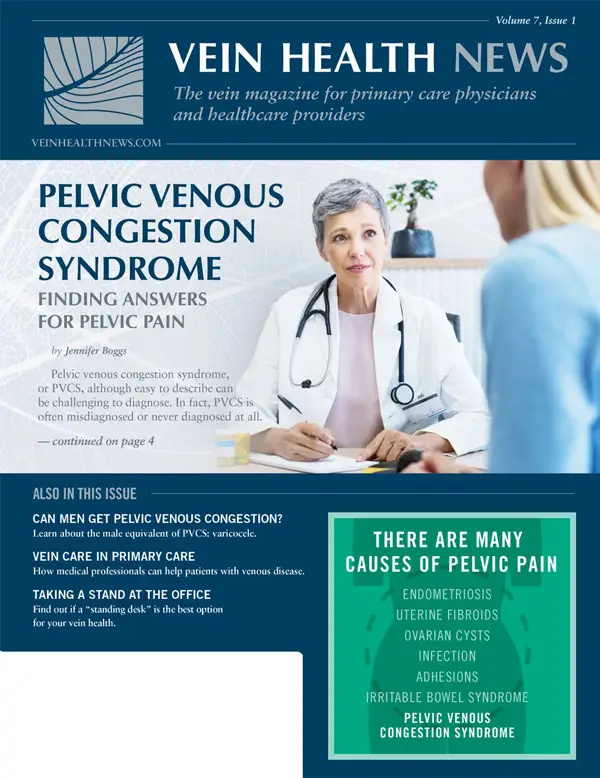
Vein Health News
The vein magazine for healthcare providers
“A heightened awareness and clinical suspicion for the specific symptomatology of PVCS may bring about a more rapid progression toward treatment.” — Dr. Joseph Gerding, Spectrum Medical Group
 Cover
Letter from the Editor
Heightened Awareness

What do veins have to do with pelvic pain? In women who have chronic pelvic pain, up to 30 percent suffer from pelvic venous congestion syndrome (PVCS). If you've never heard of PVCS, you're not alone. It is often misdiagnosed or never diagnosed at all.

It can be challenging for a physician to determine the source of pelvic pain, especially once other, well-recognized gynecological issues have been ruled out. That's why we talked to Dr. Joseph Gerding from Spectrum Medical Partners. With Board certifications in both Interventional Radiology and Phlebology, Dr. Gerding is an expert in diagnosing and treating PVCS. He helped us explain what to look for and how to look for it, as well as options for treatment.

In our second feature article, we continue the theme of raising awareness about another underdiagnosed condition: venous disease. A major part of my professional mission is to provide accurate information about vein health and treatment to physicians and medical professionals. I love talking to primary care providers, in particular, because they are seeing patients (and their legs) all the time.

PCPs may have patients who are new to vein treatment or patients who have had previous experiences with vein specialists and have been dissatisfied with traditional, more invasive procedures. (They're sometimes surprised to hear that modern vein treatment is minimally invasive and so highly effective!)

I am always available as a resource to doctors and allied health professionals. If you have questions about specific patients or general questions about venous disease, please don't hesitate to contact me.

Both pelvic pain and varicose veins can be a source of embarrassment or even shame. With this issue, we aim to raise awareness about both conditions so that patients, too, can be armed with information that will help them live full and healthy lives.

- Dr. Cindy Asbjornsen, D.O., FAVLS, RPhS, ABVLM, FACPh
← Back to Archive
Cover Story

Pelvic Venous Congestion Syndrome: Finding Answers For Pelvic Pain

By Jennifer Boggs | Feature

Pelvic venous congestion syndrome, or PVCS, although easy to describe can be challenging to diagnose. In fact, PVCS is often misdiagnosed or never diagnosed at all.

What is PVCS? Veins have one-way valves that help pump blood back toward the heart. If the valves are weak or damaged, blood can flow in the wrong direction and pool in the legs and feet, often causing them to swell. When this happens near the pelvis, it is called pelvic venous congestion syndrome. Simply put, varicose veins can also develop internally, in the pelvis, uterus and ovaries.

Diagnosing PVCS

Internal varicose veins can cause symptoms similar to those in the legs. Patients will often have visible varicose veins on their upper legs or labia, but not always. The main symptom is pelvic pain that lasts for six months or more.

Patients with PVCS report a prolonged deep and dull ache, often associated with movement, posture, and activities that increase abdominal pressure. Similar to varicose veins in the leg, the achiness that increases with prolonged standing can often be relieved by lying flat or elevating the legs.

Chronic pelvic pain (CPP) occurs below the belly button in the pelvis. The pain may be unilateral or bilateral – meaning on one side of the pelvis or both – and is often more pronounced on one side than the other. The pain is chronic and appears to have no obvious source. Symptoms may also include rectal discomfort or increased urinary frequency, bloating or gastrointestinal (GI) symptoms.

According to some studies, more than 26% of women suffer from CPP, but data about its prevalence is incomplete. When taking into account the number of factors that could also cause chronic pelvic pain, one can see how misdiagnosis by medical professionals might occur.

For example, 71 percent of cases of chronic pain in the pelvis may be associated with dyspareunia (pain during sexual intercourse), 66 percent of cases may be due to dysmenorrhea (pain associated with menstruation), and 65 percent of cases of chronic pelvis pain are diagnosed as postcoital ache (pain following sexual intercourse).

Conditions range from problems in the gastrointestinal tract to gynecologic diseases and urologic abnormalities. While some of these conditions are easily diagnosed, other causes of chronic pelvic pain are extremely difficult to recognize and have often been underdiagnosed or overlooked—even though studies show that PVCS occurs in up to 30 percent of patients who have chronic pelvic pain.

A heightened awareness

Dr. Joseph Gerding, a physician at Spectrum Medical Group in Maine, has Board certifications in both Interventional Radiology and Phlebology. According to Dr. Gerding, an evaluation by a gynecologist is a fundamental part of the patient's assessment in diagnosing chronic pelvic pain.

He believes, however, that input from other specialties – such as gastroenterology, urology, oncology, phlebology, and interventional radiology – may also be necessary because the reasons behind the pain are so many and varied. In addition, said Dr. Gerding, "a heightened awareness and clinical suspicion for the specific symptomatology of PVCS may bring about a more rapid progression toward treatment."

PVCS usually affects women who have previously been pregnant, because the ovarian and pelvic veins widened during pregnancy to accommodate the increased blood flow from the uterus. After the pregnancy, some of these veins remain enlarged and fail to return to their previous size, causing them to weaken and allow blood to pool or flow in the wrong direction.

Similar to varicose veins in the legs, venous congestion in the pelvis often first manifests during or after a pregnancy and worsens with subsequent pregnancies. Risk factors for PVCS may include a family history of the condition, hormonal influence, pelvic surgery, multiple pregnancies, a retroverted (tilted) uterus, and a history of varicose veins. African American women and women over 35 years of age have a lower risk of developing this condition.

How do you know?

Diagnosis begins with a physical examination. According to Dr. Gerding, in a patient with characteristic symptoms, the examination will typically indicate ovarian tenderness, cervical motion tenderness, and uterine tenderness with direct palpation (feeling with the hands). In one study, the combination of tenderness with a history of postcoital ache was 94 percent sensitive and 77 percent specific for discriminating PCVS from other pelvic conditions.

After an initial exam, a number of non- or minimally-invasive diagnostic tests can be performed to determine whether chronic pelvic pain is a result of pelvic varicose veins. These tests include pelvic ultrasound, pelvic venography, Computed Tomography (CT), and Magnetic Resonance Imaging (MRI).

Pelvic ultrasound: There are three diagnostic criteria for establishing the diagnosis of PVCS: (a) tortuous pelvic veins with diameters greater than 4 mm, (b) slow blood flow (about 3 cm/s), and (c) dilated veins in the outer one-third of the myometrium (arcuate veins) that communicate between bilateral pelvic varicose veins. Ultrasound (US) can also be used to exclude pelvic neoplasms (tumors) and uterine pathology as potential causes of pain.

Cross-sectional Imaging: Computed Axial Tomography (CAT), and Magnetic Resonance Imaging (MRI) are noninvasive methods that use special x-ray equipment to create detailed scans of areas inside the body. CAT and MRI identify pelvic venous changes better than US, and they may be indicated as part of the evaluation of pelvic pain to exclude or to further characterize pelvic pathology other than pelvic varices, or pelvic varicose veins.

Venography: Many investigators recommend selective ovarian and internal iliac venography in patients with symptoms of PVCS. The minimally invasive procedure involves inserting a very thin catheter into the femoral or jugular vein in order to inject a colored fluid into the ovarian veins. The venogram shows which way the blood is flowing, as well as how quickly.

Venography is more sensitive than US since it can be performed in the upright or semi-upright position with a tilting table. The Society for Vascular Surgery (SVS) and the American Venous Forum (AVF) clinical practice guidelines recommend retrograde ovarian and internal iliac venography as the test of choice for the diagnosis of pelvic venous disorders.

Laparoscopy: Characteristic pelvic venous changes can sometimes be visualized at laparoscopy, a surgical procedure in which a fiber-optic instrument is inserted through the abdominal wall to view the organs in the abdomen. However, laparoscopy is less sensitive than venography for the diagnosis of PCS. As with pelvic US, diagnostic laparoscopy is generally utilized to exclude other causes of chronic pelvic pain.

CAN MEN SUFFER FROM PVCS?

There is a male equivalent of pelvic venous congestion: varicocele (pronounced var-i-koh-seel). A varicocele is a dilation and reflux of the veins within the scrotum (the pouch of skin that holds the testicles), and it is similar to a varicose vein that might develop in the leg.

According to Dr. Joseph Gerding, although there are similarities to venous reflux in the sex organs of men and women, there are, of course, differences. When a woman has varicosities in the pelvis, they communicate with the internal iliac veins, which then communicate with veins down the legs. That means that when you see a woman with varicose veins in the legs, it is possible to trace the problem to veins in the pelvis.

In men, the testicular veins don't have that same kind of communication with the legs, because those veins are external to the body and thus more isolated from other veins. In other words, testicular varicose veins in men and varicose veins in their lower limbs are not often interrelated.

Varicocele occurs in 15-20% of males after puberty, but only 2-10% of men with a varicocele experience symptoms. When symptoms do appear, they may include testicular atrophy (testicles that decrease in size and remain small) or, more rarely, pain that increases with standing over a prolonged period of time but is relieved after lying down.

Varicoceles are also a common cause of low sperm production and decreased sperm quality, which can cause infertility, but not all varicoceles affect sperm production. Most varicoceles develop over time, sometimes enlarging and becoming more noticeable. Varicocele might cause one testicle to swell, almost always on the left side.

Treatment for varicoceles is similar to women with PVCS: surgical ligation or percutaneous (through the skin with a needle) venous embolization. Typically, a urologist or interventional radiologist can perform the ligation as treatment.

Fortunately, most varicoceles are easy to diagnose and many don't need treatment because they don't cause any symptoms. However, if someone is experiencing pain or swelling in the scrotum, he should contact a physician to rule out other conditions, some of which may require immediate attention.

Treatment for PVCS

There are a number of treatments for those diagnosed with pelvic venous congestion syndrome: medical, surgical, and minimally invasive. (In Maine, there aren't many medical professionals who regularly treat this disorder.)

One medical approach is the use of pharmacologic agents to suppress ovarian function, such as medroxyprogesterone or gonadotropin-releasing hormone. Though it may offer short-term pain relief, the long-term effectiveness of these drugs has not been proven. Additionally, women treated with medroxyprogesterone acetate reported rapid return of pain after cessation of treatment, which further suggests that hormonal therapy suppressed pain rather than cured it long-term. (The findings from relevant studies are limited, due to their small sizes and lack of a placebo groups.) The risks of medical therapy are low.

Surgical approaches include hysterectomy with unilateral or bilateral salpingo-oophorectomy (BSO) and ovarian vein ligation and excision with interruption of as many collateral veins as possible. Hysterectomy with BSO may be helpful for women with PVCS, but the data is inconsistent. In one study of women who underwent this procedure, 67 percent of patients reported no pain at one year, while a different study reported a non-significant trend toward improvement at one year. Hysterectomy with BSO is an option for women who have failed other treatment modalities, but women should be counseled that the surgery may not resolve their pain.

Surgical ligation of the ovarian veins has been associated with improvement in pain in approximately 75 percent of patients. The goal is to isolate the ovarian vein significantly above the pelvic brim (the edge of the pelvic cavity) and before the vein becomes substantially dilated.

Ovarian vein embolization (OVE) is a same-day treatment typically performed by interventional radiologists. The physician gains access either through a large vein in the groin or the neck by using a small catheter, which is a flexible tube like a strand of spaghetti. The catheter is moved through the vein to the enlarged pelvic veins, allowing the introduction of embolic agents, which are medications that cause the vein to seal off and relieve the painful pressure.

This treatment is less expensive than surgery and much less invasive. In addition, the reported technical success rates of ovarian vein embolization range from 89-100% with clinical success rates of 58-100%. Complication rates of 4-8% have been reported. According to the SVS/AVF clinical practice guidelines, embolization of refluxing ovarian veins with coils, plugs, or sclerotherapy (usually in combination), has become the standard approach for management of PVCS.

Index of suspicion

Historically, women with chronic pelvic pain have been frustrated by their lack of understanding about why they suffer from pain and available resources for treating it. PVCS is a diagnosis of exclusion. It's not the first thing that's thought of as the source of a woman's pain. Once gynecologists exclude ovarian cysts, infection, adhesions, endometriosis and other well-recognized gynecological disorders, they may never consider pelvic venous congestion.

With their deep understanding of the venous system – and access to it through imaging – phlebologists are almost always the specialists who recognize refluxing pelvic veins. They work closely with interventional radiologists to confirm a diagnose and to make a plan for treatment.

But Dr. Gerding believes that recognizing pelvic vein issues doesn't have to be limited to vein specialists and radiologist: "It takes a heightened awareness, education, and an 'index of suspicion.'"


RESOURCES

  • Alebtekin Ahangari, BSc. PT. Prevalence of Chronic Pelvic Pain Among Women: An Updated Review. Pain Physician 2014; 17:E141-E147
  • O’Brien MT, Gillespie DL. Diagnosis and treatment of the pelvic congestion syndrome. J Vasc Surg Venous Lymphat Disord. 2015 Jan;3(1):96-106. doi: 10.1016/j.jvsv.2014.05.007. Epub 2014 Jun 25.
  • Whiteley MS, Lewis-Shiell C, Bishop SI, Davis EL, Fernandez-Hart TJ, Diwakar P, Beckett D. Pelvic vein embolisation of gonadal and internal iliac veins can be performed safely and with good technical results in an ambulatory vein clinic, under local anaesthetic alone – Results from two years’ experience. Phlebology. 2018 Sep;33(8):575-579. doi: 10.1177/0268355517734952. Epub 2017 Oct 9.
  • RadiologyInfo.org. Ovarian Vein Embolization. bit.ly/2CrVzJn

FAVQ

Standing Desks Are All The Rage At Workplaces Now—Would You Recommend Them?

By Dr. Cindy Asbjornsen

The short answer is: maybe. Let me explain. In 2015, a meta-analysis in the Annals of Internal Medicine found that "prolonged sedentary time was independently associated with deleterious health outcomes regardless of physical activity."

The studies showed that physical inactivity (the fourth-leading risk factor for death for people all around the world, according to the World Health Organization) can lead to premature death from cardiovascular issues and cancer, as well as cause chronic conditions such as Type 2 diabetes. Too much sitting can also increase the risk of getting varicose veins. If you already have vein issues, you may notice that symptoms get worse after sitting for prolonged periods of time.

So is standing any better? Compared with the research on prolonged sitting, relatively little research has been done to study the health effects of prolonged occupational standing. The few studies that do exist have demonstrated a relationship between prolonged standing at work and various health outcomes such as elevated risk of heart disease and musculoskeletal pain.

We covered this subject in a previous issue of Vein Health News. In the article "Standing on the job: How at-risk occupations put a strain on veins," we discussed the risks of people with jobs that keep them on their feet all day, such as teachers, hair dressers, medical professionals, and many others. We can add to that list people who work at a standing desk all day.

From a venous standpoint (so to speak), remaining in the same position too long – whether you're sitting or standing – leads to poor blood circulation (hydrostatic venous pressure) and blood pooling in the lower limbs, which can lead to varicose veins over time.

If you do opt for a standing desk, consider using a balance board to keep you continuously contracting and relaxing your calf muscles, not to mention strengthening your core muscles. (Whether this helps with work productivity depends on the individual!)

If you choose to stick with a traditional sitting desk, an exercise ball chair, motion stool, or "wobble chair," can provide you with the same kind of calf muscle readjustments throughout the day. There are also adjustable desks that allow you to switch between sitting and standing positions throughout the day.

In conclusion, if you find standing desks more comfortable or effective, then by all means, use one. Regardless of the kind of desk you use, take regular breaks from standing or sitting for extended periods of time. Set your alarm to remind you to take a brief walk, or simply do some deep knee bends, or other stretching exercises.

Perhaps the simplest circulation-promoting exercise is the calf pump. In this simple toe-tap exercise, you tap both of your feet for a minute or two, going back and forth between heels and toes. This squeezes the deep veins in the legs and forces the blood to circulate through the leg. It feels great whether you've been sitting or standing for a long period of time.


Primary Care

How PCPs Can Advance Vein Care

By Benjamin Lee

The U.S. has one of the highest incidences of venous disease in the world. Because of the widespread nature of its symptoms, it is considered a significant public health issue.

Historically, however, venous symptoms have often gone untreated due to discouraging outcomes and the lack of quality treatment options. Just decades ago, "vein stripping" to remove the vein causing the insufficiency was the accepted treatment. Today, non-invasive procedures, such as endovenous laser ablation (EVLA), have become the gold standard of care; they have a 98% long-term success rate.

Regardless of the advances in vein care, it is still common for venous disorders to be undiagnosed or undertreated. As a result, many people experience chronic pain, sleeplessness, or symptoms of discomfort. Many patients are not aware that venous disorders are progressive and as a result, their symptoms intensify, sometimes leading to serious medical complications. Others feel they must live with unsightly varicosities that affects their engagement in social activities and may erode their confidence, and ultimately, their health and well-being.

Venous disease as a component of patient care

Physicians who encounter patients with, or are at risk for, venous disease are on the front line of reducing the growing number of people suffering with symptoms. By discussing the latest information with patients concerning modern approaches to testing, diagnosis, and treatment, the medical community can make an important contribution toward improving well-being and quality of life for thousands of people across the country.

It is common to encounter patients who feel varicose veins are "just" a cosmetic problem and thus, they do not seek treatment. It is also common for patients who have strenuous jobs that require physical activity (or long periods of standing) to think that fatigue or chronic pain is simply part of their life. In fact, men often suffer from more advanced venous disease because they are less likely to seek treatment for pain, fatigue, or varicosities.

Many patients fail to understand the consequences of early stage venous disorders, nor do they realize that treating the source of venous insufficiency can prevent complications such as an increased risk of blood clots, advanced pain, worsening appearance, edema, or ulcers. By integrating venous health into physical examinations, fewer patients will suffer from this extremely treatable disease.

Primary care physicians – and other medical professionals who see patients as part of their practice – play a central role in advancing the public's understanding of vein disease. When patients understand their disease and are informed about options for treatment, they are more likely to have a positive interaction with their PCP, receive quality care, and improve their quality of life.

WHAT YOU CAN DO AS A PRIMARY CARE PHYSICIAN
  • Know the risk factors of venous disease and the populations most at risk. Ask patients about their symptoms.
  • Don't underestimate or diminish the effect that varicose veins and other venous symptoms can have on patients.
  • Inform patients who may have had previous treatment, or those who have been dissatisfied with traditional, more invasive approaches, about today's treatment options.
  • Inform patients who may be at risk about their options for screening, prevention, and treatment.
  • Provide an information sheet to patients with risk factors and/or symptoms of venous disease.
  • Maintain a current knowledge base of venous risks, symptoms, and care.
  • Tell patients how to decrease their risk of deep vein thrombosis.
  • Identify patients at risk and refer them to a Board certified vein specialist for prevention and education.

Specialized care

It is important that patients who are experiencing symptoms, requesting evaluation, or inquiring about cosmetic vein removal receive a referral to a vein specialist who can assess the source of the insufficiency and provide professional medical care.

While the presence of a vein insufficiency can often be diagnosed in the superficial vein, only comprehensive examination by a Board-certified phlebologist can identify the source of insufficiency. In addition, ultrasound mapping and interpretation by a highly skilled vascular sonographer is paramount to receiving an accurate diagnosis.

Treatment by uncertified providers – or treatment of cosmetic concerns without taking the overall health and venous health of the patient into account – is a common consequence of the ease of today's modern treatment. Without a full understanding of both vein health and pathology, wrong treatment options can cause more damage to the venous system. Thus, it is critical that patients be treated by a Board-certified phlebologist who can provide professional medical care and, like the primary care physician, is committed to the patient's overall health.


Patient Perspective

Planes, Veins and EVLA

By Jen Boggs

Beth Dennis lives in Ogunquit, Maine, but she works in California. The 55-year-old nurse works for a national company that provides healthcare and rehabilitation in homes and hospitals. As a district director, she oversees the clinical operations for five long-term care facilities in the East Bay.

Beth flies from Maine to California every Monday and then flies home on Friday. It takes all day to get from one coast to the other; when she's at work, she's on her feet for most of the day; and she's had vein problems most of her life—a triple whammy in terms of venous health.

Like many people, Beth inherited "bad veins." Her mother had varicose veins, and all but one of her six siblings have "pretty significant" varicose veins. Beth also has a 35-year-old son with extreme varicosities.

Over time she has experienced more and more problems with varicosities. After the birth of her second child, she had a vein stripping done and then another one in the mid 1990s. In addition, up until the last ten years, Beth has suffered from obesity. She believes that the extra weight combined with the venous insufficiency also caused edema in her legs that's been difficult to keep in check.

"It feels like I've been managing this for more than 30 years," said Beth. "And my legs are still a hot mess despite everything that's been done to them."

Her occupation has exacerbated her issues, as she spends 10-12 hours on her feet during the week, paired with a commute that requires traveling for hours in a plane twice a week. Despite reducing her weight significantly and wearing compression socks daily, Beth was struggling again with achiness in her legs. By mid-afternoon the pain would be so great she'd have to "pop an ibuprofen" to get through the day.

After going to a Board-certified phlebologist for an evaluation, Beth learned about the advances in vein care since the days of vein stripping – and the importance of locating, and treating, the "leaky" vein valve at the source.

"The science behind it seems so much more advanced, and I was excited to hear that, unlike vein stripping, there wasn't going to be any down time," she said.

After initial endovenous laser ablation (EVLA), Beth is no longer feeling any discomfort in her legs, however her ultrasound evaluation showed that "there was a lot of work to be done." She has begun to wear full-length compression stockings on flights and at work, and she plans to finish her recommended treatment plan, which will include several sessions of sclerotherapy.

While improved health is Beth's number one goal of treatment, she admits that she'd one day "like to wear a pair of strappy sandals or shorts and not be embarrassed."

As Beth continues the process, she has this advice for people with similar problems: "The treatment modality is basically painless and simple. If you can get rid of the pain and edema and the harm that the long-term edema causes – you'd be a fool not to do it."

Concerned about your vein health?

Contact the Vein Healthcare Center for an evaluation.

Contact Us
View Archives