Cover Story
Caring for Seniors with Venous Disease
By Jennifer Boggs | Feature
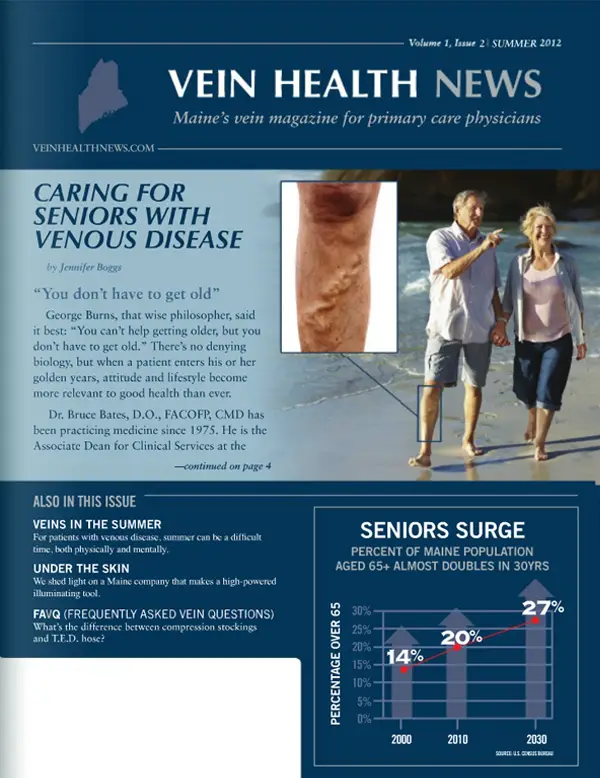
George Burns, that wise philosopher, said it best: "You can't help getting older, but you don't have to get old." There's no denying biology, but when a patient enters his or her golden years, attitude and lifestyle become more relevant to good health than ever.
Dr. Bruce Bates, D.O., FACOFP, CMD has been practicing medicine since 1975. He is the Associate Dean for Clinical Services at the University Of New England College of Osteopathic Medicine and the first-ever Chair of the Department of Geriatric Medicine. Dr. Bates believes that the biggest obstacle when caring for senior patients is ageism on behalf of the doctor and the patient. "What do you expect? I'm old," is a commonly held attitude. "The acceptance of decreased functionality as normal is a detriment to healthy and successful aging," said Dr. Bates.
Veins and aging
Paying attention to venous health is one aspect of successful aging. Venous insufficiency occurs when healthy veins become damaged and allow the backward flow of blood into the lower extremities. This pooling of blood can lead to a feeling of heaviness, aching, and can cause skin changes, such as spider veins or a brown, woody appearance of the lower legs.
Seniors' veins respond differently to everyday stress compared to that of a younger person's because vein walls are primarily made of collagen. As the body ages, a decrease in the production of collagen causes the veins to become more brittle and the valves more likely to fail, especially in the superficial veins. Thus, there is a higher incidence of varicose veins in the elderly population. Additionally, the skin begins to lose its elasticity and doesn't respond to stress the way it once did. And because skin is the "end organ" of venous disease, ulcers and bleeding varicosities can occur as a result of damaged veins.
Many seniors think varicose veins and venous stasis ulcers are a normal part of aging, but what they may not know is that they need not suffer with symptoms. Even those who experience an aching or heaviness in their legs can receive treatment and relief. Treating the symptoms also arrests the progression of their disease. One barrier to treatment is that, in the past, patients' options were limited. Vein stripping was the go-to procedure for many years. Treatment of venous disease today, however, is vastly different. Breakthroughs in phlebology and new approaches to treatment involve less time and less pain, and they are overwhelmingly successful over the long term when performed by an experienced specialist.
Common problems and solutions
Varicose veins are a frequent problem for older patients. Deep vein thrombosis (DVT) is also quite common. DVT occurs when a blood clot forms in one of the large veins usually one of the lower limbs, such as the thigh or calf leading to either partially or completely blocked venous return. The incidence of DVT is higher in older people because of Virchow's triad: 1) endothelium damage, including trauma to any blood vessel due to surgery, or even bumping into something, 2) stasis, a decreased blood flow due to immobility, and 3) hypercoaguability, an abnormal tendency toward blood clotting, due to heredity, acquired medical condition or even concurrent medications.
Physicians should consider recommending that their senior patients visit a phlebologist for a venous evaluation, prior to elective surgeries, especially hip or knee replacement. This step will help the patient learn their risks and decrease their chances of DVT. Additionally, seniors tend to be less active because of other medical conditions, such as arthritis or a respiratory issue that makes them less likely to walk or exercise. Walking causes the rhythmic contraction of calf muscles and, like a pump, forces all the blood into the deep veins and helps promote blood flow to the heart.
Although seniors have a 50% greater chance of suffering from vein disease, they have the same success rate with modern treatment options as anyone else. Modern techniques, such as endovenous ablation or ultrasound-guided sclerotherapy, are the most effective solutions for the majority of vein problems. They are minimally invasive, highly successful, and are not reserved for the young.
Snowbirds with Venous Disease
Summer can be a good time for "snowbirds" to treat their venous issues. During the warmer summer months, veins tend to dilate causing symptoms to worsen—which can inspire people to seek treatment. All venous procedures require compression stockings post-treatment, and because many seniors already wear compression stockings regularly, this becomes less of a barrier than for other patient groups.
Most snowbirds check in with their primary care doctor when they get to Maine or before they leave. Even if you only see these patients once or twice a year, this is a good time to discuss risk factors for vein disease, as well as problems that have very achievable solutions, such as varicose veins or venous ulcers. In any case, vein evaluations can take place in either the patient's summer or winter home.
Economy Class Syndrome?
Summer is a common time for seniors to schedule appointments with their primary care physicians. These visits provide an excellent opportunity to educate patients about the risks associated with long-distance travel, namely deep vein thrombosis (DVT). Though many people are familiar with the term "economy class syndrome," it is a misnomer. DVT can occur in a plane, train or automobile, regardless of what class you're sitting in.
The point is that prolonged immobility can slow down circulation and lead to blood pooling in the extremities; this significantly increases the risk of DVT. When your patient is planning to go on a long flight (or road trip, for that matter), he can prevent DVT by staying hydrated, walking in the aisles occasionally, and periodically doing simple toe-tap exercises. (Tapping the feet for even a minute—heels, then toes—squeezes the deep veins in the legs, forcing the blood to circulate.)
Summer Health
Leg Health in the Summer
By Benjamin Lee
Maine isn't called Vacationland for nothing. Every summer hundreds of people flock to the state's beaches and lakes for sailing, swimming and all manner of fun in the sun. But patients with vein problems can be acutely affected in the summer, both physically and psychologically. From a physiological perspective, most varicose veins worsen during the summer months because the heat dilates veins. Due to warmer temperatures, a leaking vein will leak even more, causing increased pain for people with existing vein problems.
In addition to physical pain or discomfort, the patient's mental wellbeing should not be underestimated. While other people are enjoying all that Maine has to offer in shorts, skirts or swimsuits, people with venous issues continue to cover up their legs. Self-consciousness about their veins can lead to unease in social situations and a diminished quality of life. Being willing to show their legs in public is a common goal for many patients with venous disease.
Treatment in summer
The treatments for venous insufficiency are the same in summer as the rest of the year, though the post-procedure considerations may be different. Minimally invasive treatments include: light-assisted sclerotherapy for small veins; ultrasound-guided therapy and ambulatory microphlebectomies for larger veins; endovenous laser ablations (EVLA) for junctional veins. After treatment, patients who have undergone any type of sclerotherapy can go out in the sun almost immediately, although wearing sunblock for six months after any vein procedure is recommended, to decrease the possibility of hyperpigmentation.
Patients can usually swim twenty-four hours after any vein treatment. Generally, there will be some bruising at the site of the procedure, but the bruises are fairly small. There are also many affordable self-tanners and cosmetics that effectively cover up bruises—short-term options that are generally preferred over a bulging varicose vein.
One possible drawback to seeking treatment for vein problems in the summer is that patients must wear compression stockings after the procedure. The length of time that patients are prescribed compression stockings is highly variable, depending upon the patient and the procedure. It could be as short as three days for light-assisted sclerotherapy, or as long as two weeks for endovenous laser ablations or ambulatory phlebectomies.
SUMMERTIME TIPS FOR PATIENTS WITH VARICOSE VEINS
- Stay cool. Heat dilates veins and causes pain and other symptoms to worsen.
- Swim and walk. Both exercises pump the calf muscles and improve circulation.
- Wear graduated compression stockings. Wearing stockings all day will keep the legs feeling as good at the end of the day as in the morning.
- Stay hydrated. Drink plenty of water and fluids.
- Elevate the legs whenever possible.
- Schedule an evaluation with a qualified phlebologist.
Source: Vein Healthcare Center
Education
What it Takes: Education in Phlebology
By Benjamin Lee
As the field of phlebology continues to grow at a rapid pace, so too do the educational opportunities for vein specialists and other health care professionals involved in the treatment of venous disease. There are two membership organizations in the United States that offer education in a variety of ways: the American College of Phlebology (ACP), founded in 1985, and the American Venous Foundation (AVF), established in 1988. Both the ACP and AVF belong to the International Union of Phlebology (UIP), the international entity founded in 1959 that serves as an umbrella organization for all national societies of phlebology.
Leaders in learning
The AVF is dedicated to improving the care of patients with venous and lymphatic disease, using education as one of its primary tools. The group seeks to educate patients and policy makers through awareness initiatives such the first national screening program for venous disease, as well as the first online venous registry in the U.S. In 1994, the AVF introduced the C.E.A.P., the first comprehensive classification system for chronic venous disease, which is now the worldwide standard.
The ACP regularly provides educational meetings and symposia, as well as online learning, printed publications and venous training videos. The organization also offers scholarships, fellowships and research grants for post-graduates and residents. One of the ACP's endeavors is the Phlebology Preceptorship Program, which matches phlebologists with health care providers. The goal is to enhance the provider's knowledge in specific areas through individual training in a clinical setting.
Passing the Test
Though phlebology is a sanctioned medical specialty by both the American Medical Association (AMA) and the American Osteopathic Association (AOA), there is a wide spectrum of knowledge and experience among professionals in vein care today. It was for this reason that the American Board of Phlebology (ABPh) was created in 2007. Its mission: to advance the care of patients with venous disorders by improving the quality of practitioners treating them, through educational and medical standards for venous care.
The Certification Examination for Phlebology is the primary instrument that the ABPh uses to ensure excellence in the field. ABPh Executive Director Christopher Freed describes the test as "rigorous and psychometrically valid." The exam is based on standards set by the American Board of Medical Specialties (ABMS). Similar to Board Certification by an ABMS Member Board, the ABPh requires Diplomate candidates to meet strict standards of education, experience, and evaluation.
Licensed physicians who apply for the exam must meet a number of prerequisite qualifications in phlebology training or experience before they are eligible to take the exam. They may do this by following one of three paths: the "fellowship route," "residency route," or "experience route." A complete list of prerequisites and necessary documentation for all three paths is available at the ABPh web site (www.americanboardofphlebology.org).
Patient Perspective
One Patient's Perspective: Exceeding Expectations
By Jennifer Boggs
Hugely swollen. Wormy looking. Hot to the touch. These are some of the words that Shaye Robbins, 44, used to describe how her legs have looked and felt for years. When Robbins was 19, bulging 1/2-inch-wide veins began appearing on her right leg and got progressively worse throughout her twenties; five years ago they started appearing on her left leg too.
"They were unattractive for sure, and they were uncomfortable," said Robbins. "But I was so used to living that way that I didn't know how uncomfortable I really was." Over the years Robbins spoke to numerous primary care doctors about her legs, but they all said that her condition was merely cosmetic. Their dismissive attitude caused her to dismiss them too, despite the obvious physical discomfort she continued to feel. By the time Robbins made an appointment with a trained and certified phlebologist, her legs were constantly achy and tired.
The vein specialist assured her that she was going to feel much better, but after years of feeling "dragged down" Robbins "couldn't understand what 'feel better' meant." The phlebologist treated her right leg—then the left leg two weeks later—using endovenous laser ablation (EVLA), a minimally invasive treatment to resolve large varicose veins. For Robbins, recovery time was quick. She wore waist-high gradient compression stockings for four weeks and walked at least 30 minutes every day, per her doctor's instructions. The change in appearance and feeling were gradual at first, but within a month, her legs looked smooth and no longer felt hot to the touch.
"At first there was a ropy feeling, and then suddenly it disappeared and my legs felt amazing—that was the most unexpected outcome for me," said Robbins. She no longer felt exhausted at the end of the day and even began looking forward to taking walks, an activity she used to loathe because her legs felt so heavy and sore.
FAVQ
Is there a link between pregnancy and venous disease?
By Dr. Cindy Asbjornsen
Is there a link between pregnancy and venous disease?
About forty percent of pregnant women are likely to develop varicose veins. The hormone progesterone, which spikes during pregnancy, can act as a vasodilator causing the valves in the veins to stretch significantly, sometimes to the point of damaging them. The result: varicose veins.
The first trimester is an especially important time to think about vein health. Women with known risk factors for venous disease should consider wearing compression stockings throughout the first three months of pregnancy and possibly longer. The most common risk factor is having a family history of venous disease. The second and third trimester may also carry some risk of developing varicose veins. The volume of blood in a healthy woman increases to about 50% more than before the pregnancy, with the largest increase in the second trimester.
Here are some things you can suggest to patients to help decrease or prevent varicose veins during pregnancy are:
- Wear graduated compression stockings, especially in the first trimester.
- Exercise often; even a brisk walk will help circulation and reduce symptoms.
- Frequently pump the foot (heel to toe), even if on bed rest.
- Avoid tight clothes or high-heeled shoes.
- Gain only as much weight as recommended by the obstetrician.
- Take a pre-natal vitamin daily.
Vein Tech
Syris Scientific
By Diane Atwood
The most common procedures for treating spider veins and telangiectasia are sclerotherapy and vascular laser treatments. The tiny blood vessels, which are generally found on the legs and face, are just below the surface of the skin. While one might think they would be easy to visualize, light that reflects off the skin's surface and refracts just below often makes it difficult, if not impossible.
Medical professionals worldwide have come to rely on technology developed in a small town in Maine to help them visualize, target, and treat these miniscule vascular structures. Syris Scientific, a company located in Gray, Maine manufactures and distributes the v300 and v600 visualization systems, which use patented cross polarization technology to filter out the glare of the light reflecting off the skin allowing visualization below the skin's surface. The technology combines high-powered, color corrected illumination with optical filters to produce optimum light density.
"It enhances the vascular structures so physicians can target the area they're supposed to be working on," said Pam Wilkinson, sales and operations manager at Syris. "And the cross polarization takes the reflective glare off the doctor's eyes so they aren't as stressed and fatigued at the end of the day. Ultimately, the doctor is able to the work easier, more effectively, and more efficiently."
The history of Syris Scientific and its illumination systems began in a research laboratory at Massachusetts General Hospital about 15 years ago. Three colleagues, Rox Anderson, MD, Nik Kollias, PhD, and Bill Farinelli invented what they named the Seymour Light. Their original prototype evolved over time, based primarily on feedback from medical professionals who used the Seymour Light when treating dermatologic conditions such as telangiectasias and pigmented lesions.
Concerned about your vein health?
Contact the Vein Healthcare Center for an evaluation.
Contact Us