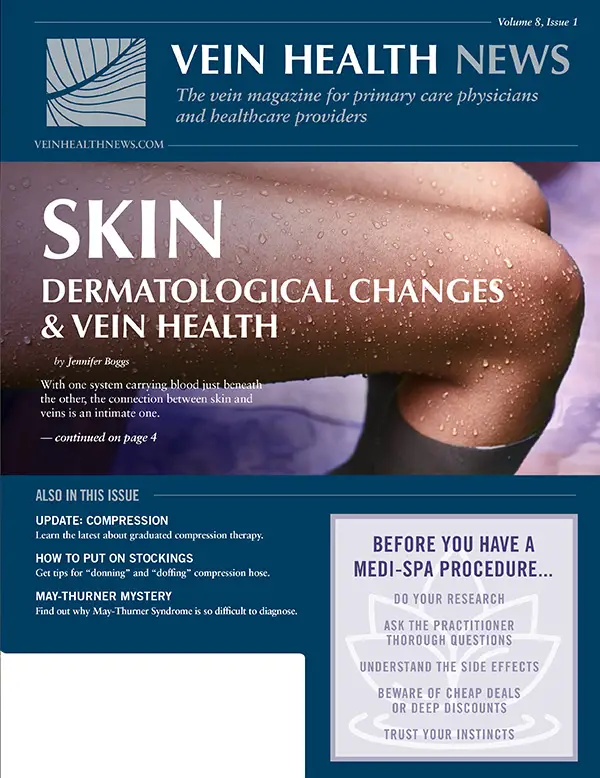
Cover Story
Skin: Dermatological Changes & Vein Health
By Jennifer Boggs | Feature
With one system carrying blood just beneath the other, the connection between skin and veins is an intimate one.
The role of veins is to carry deoxygenated blood back up to the heart, usually against gravity. In leg veins, there are valves that open to allow the blood to flow one way: up. If the valves in the veins become damaged, some blood will flow back into the legs and "pool" there, resulting in a condition sometimes referred to as venous reflux.
Venous congestion can limit the amount of nutrients that fresh blood can bring to the affected area, and skin can be dramatically affected. And because skin is the end organ of venous disease, skin changes can be an indicator of venous issues.
Skin changes are signs
Changes in the appearance or quality of the skin are common signs of venous problems. These symptoms can include the development of spider veins, the blue or purple lines that occur under the skin but are close enough to be seen on the surface, or varicose veins, large, visible veins in the leg that bulge, often pushing up against the skin.
Both spider veins and varicose veins can be signs of early stage venous disease, but there are other skin changes affecting the legs or ankles that can also be an indicator of a venous issue. All venous dysfunction is on a continuum. As veins get worse, skin changes become more serious.
A developing redness around the ankles is a common symptom, as is skin that has become harder or thicker in the lower leg. Pachydermia, for example, is an abnormal thickening of the skin, that makes the skin appear woody.
Stasis dermatitis, also known as varicose eczema, is a skin condition that results from extra fluid in soft tissues from venous reflux. Symptoms of dermatitis can include swelling, a heavy or aching feeling, or red, swollen, and painful skin, which may be weeping and crusty. These changes will usually affect the ankles first and may eventually extend up the calf. Additional symptoms may develop, such as purple or red sores, or skin that is dry, cracked, shiny, and itchy.
Untreated, this condition can gradually worsen leading to areas of thick, hard skin, or even cracks in the skin. Poor skin condition makes it possible for bacterial infection to enter the skin and develop into cellulitis.
Though common, cellulitis is a potentially serious bacterial infection of the skin and the tissues immediately beneath the skin. The affected skin appears swollen and red and is typically painful and warm to the touch. Antibiotics may be needed to treat the infection, and left untreated, cellulitis can spread to the lymph nodes and into the bloodstream and become life-threatening.
Another skin change to pay attention to is discoloration of the lower leg, ankle or foot. These brown- or rusty-colored "patches" or "stains" are known as hemosiderin deposits. When vein valves fail, regurgitated blood forces red blood cells out of the capillaries. When the red blood cells break down, the hemoglobin releases iron and is stored as hemosiderin in tissues beneath the skin, which causes the staining. Hemosiderin staining can be signs of advanced venous disease, and should be evaluated by a physician.
C.E.A.P. COMMUNICATING VEIN SEVERITY
Venous insufficiency is a progressive disease. Without intervention, the severity of symptoms will increase and complications may arise that can have a serious impact on overall health. In order to have a standard way to talk about vein problems, a group of experts created a classification system known as C.E.A.P.: Clinical + Etiology + Anatomy + Pathophysiology.
The "C" in C.E.A.P. stands for the clinical severity rating of a patient's veins and is the most significant in physician-to-physician communication. For patients, recognizing what C.E.A.P. classification they are in may help them to decide if and when to seek treatment.
Advanced stages of venous disease
Because venous disease is progressive, venous reflux can often lead to additional valve failure, and as a result, the pooling of blood can affect a larger area. When blood leaks into the tissue of the skin it can cause swelling and damage to the tissue.
Open wounds or wounds that just won't heal on the lower leg or ankle are a sign that venous disease has reached an advanced stage. At this point, the skin on the lower limbs has begun to break down from the inside out.
Venous ulcers may be painful or itchy. They are usually wet and drain a great deal, requiring constant care and dressing changes. Because ulcers do not heal on their own, they can have a significant impact on quality of life. Often, because of a poor understanding of options for treatment, people can be plagued with ulcers for years, assuming there is no alternative.
Of the three most common classes of ulcers – diabetic, arterial, and venous – venous is the most common, thought to account for approximately 80% of chronic leg ulcers. Venous ulcers usually occur on the lower leg below the knee. They tend to be ruddy in color, have irregular borders, and the surrounding tissue may be red or hyper-pigmented due to hemosiderin staining. (In contrast, the wound bed of an arterial ulcer tends to be black, grayish, or yellow and they have very smooth borders.)
The most accurate way to diagnose a venous ulcer is with a duplex Doppler ultrasound, which reveals whether or not the blood is flowing in the proper direction, or if there is any pooling occurring. With any wound, it's important to identify the right etiology, or cause of the condition. Different types of ulcers may appear similar, but each one has a different cause and thus, very different treatments.
How vein treatment impacts the skin
If the skin changes discussed in this article are indicators of vein disease, then it stands to reason that treating the venous disease can have a positive effect on the skin. But can treating the skin impact the veins?
The short answer is that you can treat the symptom without treating the cause. For example, moisturizer or steroidal cream may help to curb itchy, dry, or scaly skin temporarily, but if the cause of the skin condition is venous in nature, then addressing the vein problem at the source is the best way to resolve the skin issues long-term. Even those who are experiencing late-stage conditions like venous ulcers can have excellent success with vein treatment.
Phlebologists (vein specialists) regularly use the skin as a guide for diagnosis and treatment. The C.E.A.P. classification system – Clinical, Etiology, Anatomy, and Pathophysiology – gives phlebologists a standard way to talk about patients' vein problems. C.E.A.P. classification includes various skin conditions, such as pigmentation or ulceration. (The "C" in C.E.A.P. stands for the clinical severity rating of a patient's veins and is the most significant in physician-to-physician communication.)
While phlebologists focus mainly on legs and dermatologists focus on the whole body (skin is the largest human organ), the two specialties often overlap. In fact, numerous dermatologists have been major thought leaders, pioneers, and educators in phlebology in the U.S.
Dermatologists often refer patients to vein specialists if they present with symptoms that are consistent with venous disease. Likewise, phlebologists see a lot of skin and will recommend that patients see a dermatologist if the condition appears to be something other than venous in nature. The C.E.A.P. classification and good communication among specialists are key to the best possible patient care.
RESOURCES
- Causes ulceration Mekkes JR et al. Br J Dermatology [2003;148:388-401]
- Etiology of venous ulceration Gourdin FW, Smith JG Jr. Southern Medical Journal [1993, 86(10):1142-1146]
- Revision of the CEAP classification for chronic venous disorders: Consensus statement American Venous Forum International Ad Hoc Committee for Revision of the CEAP Classification. Journal of Vascular Surgery [2004; 40(6):1248-1252]
Aesthetics & Medicine
Medi-Spas: Aesthetics Meets Medicine
By Vein Health News Staff
The American Med Spa Association (AmSpa) defines a medical spa as a hybrid between an aesthetic medical center and a traditional day spa. Commonly known as a med spa or medi-spa, these businesses typically blend relaxation and aesthetic services for the face, body, and hair with more specialized clinical treatments that may include laser treatments, injectable cosmetic medicine, or chemical peels.
According to AmSpa's 2017 Medical Spa State of the Industry Report, there are more than 4,200 medi-spas in the U.S., and their popularity continues to grow.
Liz Rappolla, owner of Rejuvenations in Falmouth, opened one of the first medi-spas in Maine in 2001. Since then, Rapolla has seen at least half a dozen medi-spas open, especially in the southern part of the state.
"When I got here eighteen years ago, the state of Maine didn't have that license because I was the first," said Rapolla. "They looked at other states for guidance and gave me a cosmetology license but with a 'medical spin.'"
Before You Have A Medi-Spa Procedure...
- Do your research. Go online, but also talk to the provider. Ask lots of questions about the procedure, expected results, recuperation, and what happens if there are complications.
- Check credentials. Laws on medi-spa treatments (including lasers and fillers) vary from state to state. Make sure your practitioner has the training and credentials to treat you. It's okay to ask.
- Understand the side effects. Know what potential risks are and weigh them against the benefits.
- Beware cheap deals or deep discounts. Of course some medi-spas will offer deals, especially to new clients – but if it seems too good to be true, it probably is.
- Trust your instincts. If a provider is evasive, defensive, or you just don't feel comfortable, trust yourself.
These days, Rapolla says, she is taking Rejuvenations in a more medical direction. With many older clients and clients who suffer from pain, even traditional spa services like pedicures and massages are as therapeutic as they are cosmetic or relaxing.
Rapolla is a medical aesthetician with licenses in New Jersey, New York, and Pennsylvania. Her daughter, Mia Rapolla, also works at Rejuvenations. She has her Bachelor's degree in Nursing and is studying to become a Registered Nurse. Although every state varies in both training and licensure, the Rapollas ensure that their staff are properly trained and supported in their continuing education.
BUYER BEWARE
While some medi-spas offer vein treatments, consumers should first check that the practitioner is properly trained. The best way to ensure that someone treating veins has the knowledge, skills, and experience to provide quality care to vein patients is to confirm that they are certified by the American Board of Venous & Lymphatic Medicine (ABVLM), formerly the American Board of Phlebology.
Rejuvenation provided sclerotherapy years ago when their medical director was a certified vein specialist, but since then they refer clients to board-certified specialists who can thoroughly assess the issue is and treat it at the source.
"If I see someone with vein problems, I suggest that they have go to a professional who can give them the right protocol from day one so that the problem doesn't get worse," said Rapolla.
She urges the same cautious approach no matter what the procedure. In the wrong hands, even cosmetic enhancements such as Botox and other fillers can be a waste of money, or, worse, dangerous.
Before receiving services at a medi-spa, consumers should research the business and practitioners. Ask a lot of questions about experience, equipment, training, and licensing. Rapolla recommends having a full consultation before starting any treatment. Talk to other customers, look at before-and-after case studies, and read reviews and testimonials.
Another way to make sure that a medi-spa has high standards of care is to be wary of discounts on medical procedures, or so-called "daily deals." Don't feel pressured to make a decision because the "offer" is only available for a limited amount of time. Take your time, do your homework, and remember that in the long-run, sub-par services are not a bargain.
Patient Perspective
Solving the Mystery of May-Thurner
By Jennifer Boggs
May-Thurner syndrome is difficult to diagnose. Unfortunately, one of the few symptoms is when a patient develops a deep vein thrombosis, or DVT.
To understand May-Thurner, a brief review of the circulatory system is helpful. Blood vessels carry blood to every part of the body: arteries move oxygenated blood away from the heart, and veins bring the de-oxygenated blood back up to the heart.
The physical crossover of arteries and veins is normal, but in some cases, the blood vessels are positioned in such a way that one of the arteries presses against one of the veins; this narrowed blood flow creates a pressure that you might compare to pushing down on a garden hose.
May-Thurner syndrome involves the right iliac artery, which carries blood to the right leg, and the left iliac vein, which brings blood out of the left leg toward the heart. The right iliac artery squeezes the left iliac vein when they cross each other in the pelvis. The condition, also referred to as iliac vein compression syndrome or Cockett's syndrome, increases the likelihood of developing a DVT in the left leg.
Discovering the problem
Elizabeth Teague, age 33, is a Physician Assistant at the Harold Alfond Center for Cancer Care in Augusta, Maine. She first started noticing varicose veins in her right leg when she was just a junior in college. A few years later, varicose veins started showing up in her left leg. As she got older, both legs got progressively worse.
The veins in her right leg became uncomfortable enough that she decided to have it treated with endovenous laser ablation (EVLA). The treatment was successful and Elizabeth thought she was "in the clear," until her left leg started to feel "worse and worse." In addition to the unsightly veins, her leg felt very heavy and achy. Sometimes her leg would turn purple, even her toes.
"In 2012 I got serious about getting my left leg fixed, and I found the Vein Healthcare Center," said Elizabeth. "Dr. Asbjornsen realized that something funky was going on, because the sonogram showed a deep vein insufficiency in my left leg but not my right one."
The vein specialist suspected that because only one leg had insufficiency in her deep vein system – as opposed to in her superficial veins – that there was an irregularity going on upstream from the varicose veins in the leg, possibly in the pelvis.
When Elizabeth heard the news, her reaction was mixed: "I was so excited to learn that there was an explanation for what I was experiencing, but as someone who works in the medical field, I knew what that could mean for me physically; I was terrified that this would be a problem for my whole life."
To confirm Dr. Asbjornsen's suspicions of May-Thurner syndrome, she sent Elizabeth to an interventional radiologist for a CT-angiogram. After making an official diagnosis of May-Thurner, the radiologist placed a stent in Elizabeth's left iliac vein to open up that vein and allow the blood to flow properly.
As soon as Elizabeth recovered from the stent procedure, her left leg felt completely better. She said it was really exciting to have her leg feel "just light" and like she "had a new leg." No follow up was required to address the iliac vein compression, but she met with an interventional radiologist in Maine, just in case anything should happen in the future.
Elizabeth still had the varicose veins in her left leg to contend with, however, because of the damage that had been done over years. She had sclerotherapy treatments for the varicose veins, which all resolved, slowly but surely.
Pay attention to warning signs
May-Thurner is an anatomical issue that many people likely won't even know they have unless they get a DVT. A person might have pain or swelling in the leg, but usually, there aren't any warning signs. Elizabeth's advice is: if there are any warning signs of any health issue, pay attention and seek medical help.
The women on her mother's side always had vein issues, but none as young as she did, nor with the pain and heaviness that she had. She hopes that when a doctor sees a young patient with varicose veins, deep vein insufficiency, or even a DVT, that the next question they ask is: "Why?"
Elizabeth also recommends that, if possible, women with vein problems take care of them before they come pregnant. She was relieved that she was able to be diagnosed and treated for May-Thurner condition before her pregnancy, because she believes she would have probably developed a DVT.
"I think there's a misconception that if you're a woman you have to wait until you're done having kids to address these issues, but I'd say if you're a woman having trouble with these symptoms, go see a phlebologist," said Elizabeth. "It can improve your quality of life during pregnancy, and it can be safer than having to deal with phlebitis or a potential blood clot during pregnancy."
After Elizabeth gave birth to her daughter, a small branch of the saphenous vein in her right leg that had originally been closed became incompetent. She had a second EVLA procedure, and the varicosities in the right leg fully resolved.
With both legs feeling better than they ever have, Elizabeth has returned to her normal level of physical activity. As an avid runner, bicyclist, and skier – and the parent of a toddler – she's enjoying life to its fullest once again.
Technology
Compression Stays Current
By Benjamin Lee
The best board-certified phlebologists are always on alert for innovative ways to treat patients' vein disease at the source of the problem. Minimally invasive treatments, such as endovenous laser ablation (EVLA), radio frequency ablation (RFA), and sclerotherapy have been joined by newer procedures such as chemical ablation, mechanico-chemical ablation, and cyanocryalate adhesives.
To help patients manage their venous symptoms, vein specialists also turn to a tried and true technology: graduated compression.
The basics
Graduated, or gradient, compression stockings can prevent vein problems from occurring, relieve venous disease symptoms, and decrease the likelihood of a clot. Patients frequently report that their symptoms are significantly improved, if not completely alleviated, while wearing appropriate, well-fitted compression.
Compression therapy also provides an alternative for patients who opt for a more conservative treatment. Stockings can be worn for years as a long-term option for managing symptoms of venous disease.
Venous disease is defined as the impairment of blood flow towards the heart. Healthy veins have valves that open and close to assist the return of blood to the heart. Venous disease occurs if these valves become damaged, allowing the backward flow of blood in the legs. When blood cannot be properly returned through the vein, it can pool, leading to a feeling of heaviness and fatigue. This pooling could also cause varicose veins, among other problems.
Medical compression provides a gradient of pressure against the leg. The pressure is highest at the foot and ankle and gradually decreases as the garment rises up the leg. This pressure gradient makes it easier for the body to pump blood up towards the heart (the normal direction) and more difficult for gravity to pull blood downward.
Compression also increases the pressure in the subcutaneous tissue, thereby helping to reduce and prevent swelling by moving excess fluid back into the capillaries.
Gradient compression is expressed in millimeters of mercury, or mmHg. It is the measurement of how much compression or squeeze that is placed on the leg: the higher the number, the greater the compression.
Stockings are graded on the basis of the strength of the compression at the ankle. Commonly prescribed strengths include 15-20 mmHg for spider veins or patients with varicose veins but only mild symptoms or swelling; 20-30 mmHg for mild to moderate varicose veins; and 30-40 mmHg for patients with varicose veins associated with symptoms such as pain and swelling. For conditions such as lymphedema, 50-60 mmHg stockings or inelastic bandages are most effective.
Compression gains traction
Athletic compression and post-thrombotic (clot) compression garments, such as those worn by tennis star Venus Williams, have raised consumers' awareness of compression therapy. Add to that frequent travel stories about so-called "economy-class syndrome," and public awareness of compression appears to be growing.
Tom Musone, Marketing Director at compression company Juzo, has also observed an increase in consumer interest in compression for occupational use as more nurses, teachers, and other professionals who are on their feet all day look for relief for their tired, achy legs.
Musone cautions, however, that now that there is a multitude of products to choose from, consumers should be judicious about what they are purchasing and why.
"Non-medical compression may help your legs feel better, but if you have varicosities, venous reflux, or obstructions or lymphatic issues or edema – then it could be dangerous to wear consumer compression products that may not be the appropriate size or have the structure of a medical-grade compression garment," said Musone.
He suggests that people consult with a medical professional to get the proper diagnosis in order to find the most beneficial compression for each individual situation.
Someone who scores poorly on the Ankle-Brachial Index (ABI) test, for example, should not be using compression because the test may indicate peripheral artery disease (PAD). This condition of decreased flow in the arteries of the arms or legs would mean greater risk for a stroke or heart attack – a condition that could be exacerbated by the use of compression.
According to Erik Berens, Director of National Accounts & Marketing at compression company medi USA, those with sensory impairments due to diabetes and neuropathy (nerve damage) should also be cautious with regard to compression.
A physician or specialist will prescribe different types of garments depending on the type of disease, the location of the damage to the veins, and how far it has progressed. Different lengths of compression garments may be recommended, including knee-length, thigh-length and full pantyhose-style garments. There are also special models designed for men and pregnant women.
There is a simple rule of thumb for selecting the right garments, explained Berens: the more severe the damage to the venous system and the softer the leg tissue, the thicker and firmer the garments must be. The severity of a venous disease determines the gradient pressure required.
Again, a medical professional should be the one to assess the patient's condition and degree of severity, not the patient alone.
Buyer, be knowledgeable
Like any product, the quality of compression products varies. At best, inexpensive compression socks, perhaps purchased online, might not have any therapeutic benefits. The worst case scenario is that the product is ill-fitting or the incorrect dosage and could cause damage.
"Medical compression garments are not the same as cheap options marketed to consumers as 'compression,'" said Musone. "Go get fitted for a comfortable garment in a style you like – it will cost a little more, but you'll be more likely to wear it and, thus, effectively manage your condition."
Some lower quality garments may also be harder to get on and off, and they're often not as durable. (To learn more, see "How to Put on Your Stockings" below.)
Most medical compression socks and stockings are machine washable and suitable for tumble drying to ensure that they're easier to care for and further increase patient compliance. (Berens recommends washing garments in the evening because the fabric collects flakes of skin, sweat, and lotion residue, which may damage the threads and cause the fabric to lose its elasticity.)
Although more people these days are aware of the therapeutic benefits of compression, people just entering the market may still have the misconceptions that stockings are beige, unfashionable, or uncomfortable. What vein specialists would like patients to know is that compression will make their legs feel better, not to mention the rest of their health.
"What I found really amazing is that people who use compression often sleep better at night and feel better in the day," said Berens who wears a three-quarter stocking himself almost every day. "People are always pleasantly surprised when they actually put them on how good they feel, like a comfortable hug for their legs."
HOW TO PUT ON YOUR STOCKINGS
DONNING MANUAL METHOD
Before putting on your compression stockings, take off your watch and any jewelry. Wear rubber gloves to avoid damage to the fabric and to help grip the fabric, making it easier to put on your stockings. Avoid overstretching by pulling excessively, as loose stockings won't fit properly. Overstretched fabric will cause incorrect pressure distribution, and a full leg stocking may slip down and gather around the back of the knee. This can lead to your leg feeling strangled at the knee.
- Reach into the stocking with the rubber glove and grasp the heel.
- Turn the stocking inside out to the heel leaving the foot only correct side out with the leg fabric over it.
- Pull the stocking over your foot up to the heel.
- Grasp the upper layer of fabric in the middle of the foot.
- Lift the fabric fold over your heel.
- Grasp the hanging fabric with both hands.
- Fit the fabric evenly over your calf.
- Slide the stocking step by step up to the knee.
- Grasp the fabric again and pull over your knee.
- Check that the whole stocking fits properly.
DONNING BUTLER METHOD
- Spread stocking out lengthwise and place in the butler stirrup, or inner frame.
- With toe of stocking pointing forward and heel closest to you, turn stocking inside out over stirrup.
- Carefully slide stocking down over the stirrup until heel appears over the edge of the frame.
- Now slip foot, toes first, into the tip of the stocking. Lean against something firm (table, wall) while you do so.
- Slide your full foot into the stocking.
- Tilt butler diagonally backwards and pull towards your body until stocking slides off butler.
- Smooth stocking carefully up so that no wrinkles occur. This is done more easily with donning gloves.
- Pull material upwards evenly and check that stocking fits properly.
DOFFING BUTLER METHOD
- Use the medi butler off donning aid to hook onto the edge of the stocking.
- Slide down until the stocking is far enough down your leg to be easily removed.
Information courtesy of medi USA
Concerned about your vein health?
Contact the Vein Healthcare Center for an evaluation.
Contact Us